



Do open hyperbolic precision punching machines need regular maintenance
The open hyperbolic precision punching machine requires regular maintenance, and its necessity and maintenance points are as follows:
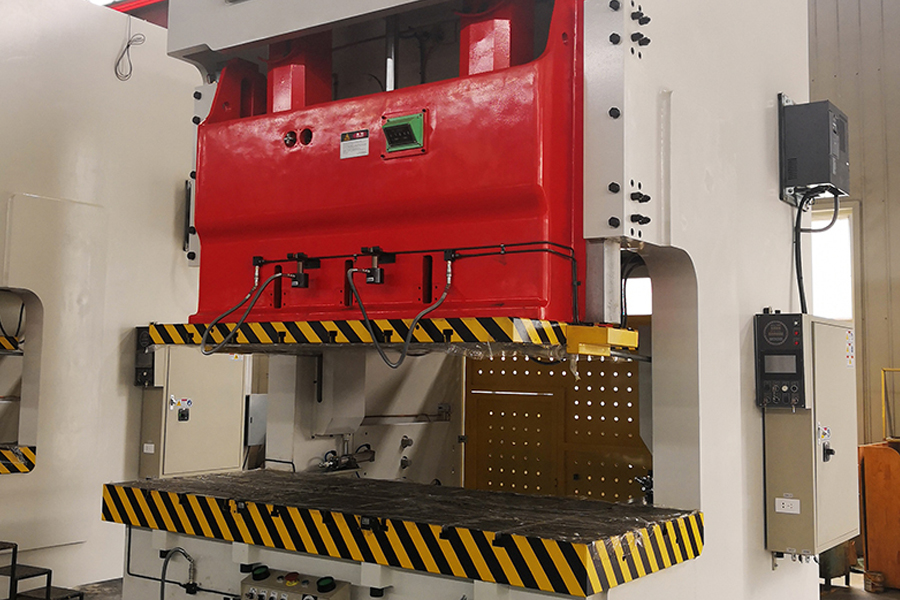
1、 The necessity of regular maintenance
Prevent performance degradation:Long term high-intensity operation of precision punching machines can lead to component wear (such as guide rails, screws, gears). If not lubricated or replaced in a timely manner, it may cause slider jamming and increased guide rail wear, directly affecting machining accuracy and equipment life.
Ensure processing quality:Precision calibration of punch press is the core link. For example, when the parallelism error of the workbench exceeds 0.02mm, it needs to be calibrated by adjusting the gasket or grinding the workbench; When the accuracy deviation of the bottom dead center of the slider exceeds ± 0.01mm, the length of the connecting rod needs to be readjusted. Regular maintenance can ensure that these parameters always meet the standards.
Reduce security risks:Safety protection devices (such as emergency stop buttons and light curtain sensors) need to be checked for functionality daily. For example, the device should stop running within 0.5 seconds after pressing the emergency stop button; When the light curtain is obstructed, the equipment must brake immediately. Regular maintenance can prevent operational accidents caused by device failure.
Control maintenance costs:By conducting regular inspections (such as cleaning the filter weekly and checking the fuel level in the tank monthly), potential hazards can be identified in advance, preventing small problems from escalating into major malfunctions, thereby reducing maintenance costs and downtime losses.
2、 The core content of regular maintenance
1. Lubrication system management:
Oil selection: ISO VG 32-VG 68 lubricating oil is used for the guide rail and screw, and high viscosity, extreme pressure resistant gear oil is selected for the gear transmission system.
Maintenance cycle: Check the oil level in the fuel tank daily; Clean the filter weekly to prevent impurities from blocking the oil circuit; The automatic lubrication system needs to monitor the oil pressure and check the oil pump and pipeline when it is below 0.2MPa.
2. Key component inspection
Sliding block and guide rail: Check the surface scratches and wear daily, measure the straightness of the guide rail with a dial gauge, and repair or adjust if the error exceeds 0.03mm/m.
Mold installation surface: Use a level to check the flatness every month, and grind and correct if the deviation exceeds 0.05mm.
Transmission system: Regularly check for gear tooth surface pitting and belt wear (replace if it exceeds 1/3 of the original thickness).
3. Accuracy calibration and restoration
Parallelism of the workbench: Check quarterly with a laser interferometer and calibrate when the error exceeds 0.02mm.
Mold closure height detection device: Regularly calibrated to ensure display accuracy error within ± 0.1mm.
4. Safety and Electrical Maintenance
Safety device: Check the emergency stop button and light curtain sensor function daily, and test the light curtain sensitivity monthly.
Electrical system: Clean the dust in the electrical cabinet every six months to prevent oxidation of the contactor contacts; Regularly inspect the insulation layer of the wire and replace it when it is damaged or aged.
3、 Extended requirements for professional maintenance
1. Semi annual maintenance
Measure the friction of the clutch brake to reduce block wear, and replace or adjust the friction to reduce block clearance (1.0-2.0mm).
Check the accuracy of oil pressure gauge, air pressure gauge and other gauges, and inspect the oil seal and O-ring for oil leakage.
2. Annual maintenance
Disassemble and inspect the clutch brake, check the wear and aging of friction blocks, lining materials, springs, and other components.
Test the performance of photoelectric safety devices, adjust the projection angle and area; Check the wear of electrical system contacts and loose connections.